

If you have ever lived with a puppy, there was probably a moment when it seemed anything could become a chew toy: shoes, chair legs, cables, toys, your hands and even the things you swore you had left out of reach.
Before you think it’s just mischief, there is something important to understand: chewing is part of how it gets to know the world and, during teething, it can become an even more frequent behavior.
In the first months of life, baby teeth start making way for adult teeth. It’s a stage of changes in the mouth that can come with sensitive gums and a greater need to chew.
That’s why, rather than trying to get a puppy to stop chewing altogether, the challenge is to accompany it while it learns what it can chew, what it can’t and how to relate to its surroundings.
A mouth that is changing
Puppies are born without teeth and, during their first weeks of life, baby teeth start to appear. Dogs have 28 temporary teeth that will later be replaced by the 42 permanent teeth they will have as adults.
This change usually begins at around three or four months and continues over the following months, although the pace can vary from one puppy to another. During this process, you may notice that it looks for things to chew more often; firm objects can be appealing when their gums are sensitive, but chewing isn’t only about teething.
A puppy also uses its mouth to explore, play, interact and learn. It’s one of the tools it has to discover what is around it. So finding a puppy chewing a table doesn’t necessarily mean it is “misbehaving”. It means it is still learning to relate to its surroundings and needs us to show it the right options.
Why does it seem to want to chew everything?
Part of the answer is that puppies are going through a stage of enormous learning. A new texture, an object that moves, something that makes noise or simply something within reach can become a chance to explore. And the mouth plays a big part in that process.
During teething, this need can also become more obvious. Their gums may be sensitive and chewing certain objects can feel good, which is why it’s so common for a puppy to go from its toy to your shoe in a matter of seconds.
The solution isn’t to turn the house into a place where nothing can be touched. It’s to make it easier for it to find what it can chew, and harder to reach what could be dangerous or what we simply don’t want it to destroy.
You might be interested in: Restless puppies: how to channel their energy and avoid destructive behavior
The key isn’t forbidding: it’s offering alternatives
A puppy needs opportunities to chew. If every time it does it hears a “no” but never finds a clear alternative, it will hardly understand what we expect of it. Suitable chews and toys can become an important tool during this stage. Having different textures and shapes lets you offer it options to explore and chew while you watch which ones interest it most.
You can also use the moments when it looks for something to chew to redirect its attention. If it grabs your hand during play, for example, avoid turning the moment into a chase or a tug-of-war. Stop the interaction and offer a toy it can chew.
When it chooses it, reinforce that behavior positively and, over time, repetition helps build a simple association: this is for chewing.
Some things are better kept out of reach
Supporting teething also means preparing the space. Cables, small objects, medicines, cleaning products, remote controls and other items that could break, be swallowed or pose a risk should be kept out of a puppy’s reach.
This doesn’t mean you are “spoiling” it or that you have to watch it every second. It means recognizing that it doesn’t yet have the same self-control as an adult dog. Besides, a puppy doesn’t understand that the old shoe can be chewed but the new one can’t. To it, both can be interesting objects.
That’s why, while it learns, prevention is also part of training.
What if we find a tooth?
During teething you may find a baby tooth on the floor, on a toy or even in its food. It can also happen that you never find any: many puppies end up swallowing the teeth that fall out, and this can happen without being a problem.
An occasional small trace of blood may also appear when a tooth comes out. However, not everything that happens during teething should automatically be put down to the process.
If you notice heavy or persistent bleeding, a strong bad smell, marked swelling, difficulty eating, obvious pain or a baby tooth that stays in place while the adult one comes in, the right thing to do is to see your veterinarian.
In particular, so-called retained baby teeth deserve a check-up, as they can affect the position of the permanent teeth and lead to other problems in the mouth.
The most important rule is simple: if something makes you unsure about the health of its mouth, don’t try to solve it only at home.
It also needs to rest from the adventure
A puppy doesn’t only need physical activity. During these first months it is constantly processing new information: people, sounds, smells, spaces, objects and household rules.
That’s why, besides offering it toys and chews, it’s important to give it opportunities to explore with its nose, learn small cues and have moments of rest.
A search game, hiding part of its food for it to find or practicing a simple behavior for a few minutes can help keep its mind busy and then let it sleep.
Rest is a fundamental part of a puppy’s life. When it is overtired, overstimulated or hasn’t had enough breaks, some behaviors can become more intense, including the need to chew.
Supporting this stage also means learning to recognize when it needs activity and when it simply needs to stop.
Patience can be learned too
It’s easy to lose it when you find another chewed shoe or when your puppy decides your hands are the best toy in the house. But this stage isn’t about getting a puppy that never chews; it’s about helping it develop good habits while it goes through a natural stage of growth.
Every time you remove a dangerous object, offer it an alternative, acknowledge a good choice or patiently repeat a rule, you are building learning; and that learning takes time.
You might be interested in: How to help your pet stay calm day to day
During the first months, we can also look for ways to accompany the puppy’s wellbeing while it goes through all these changes.
Support for this stage
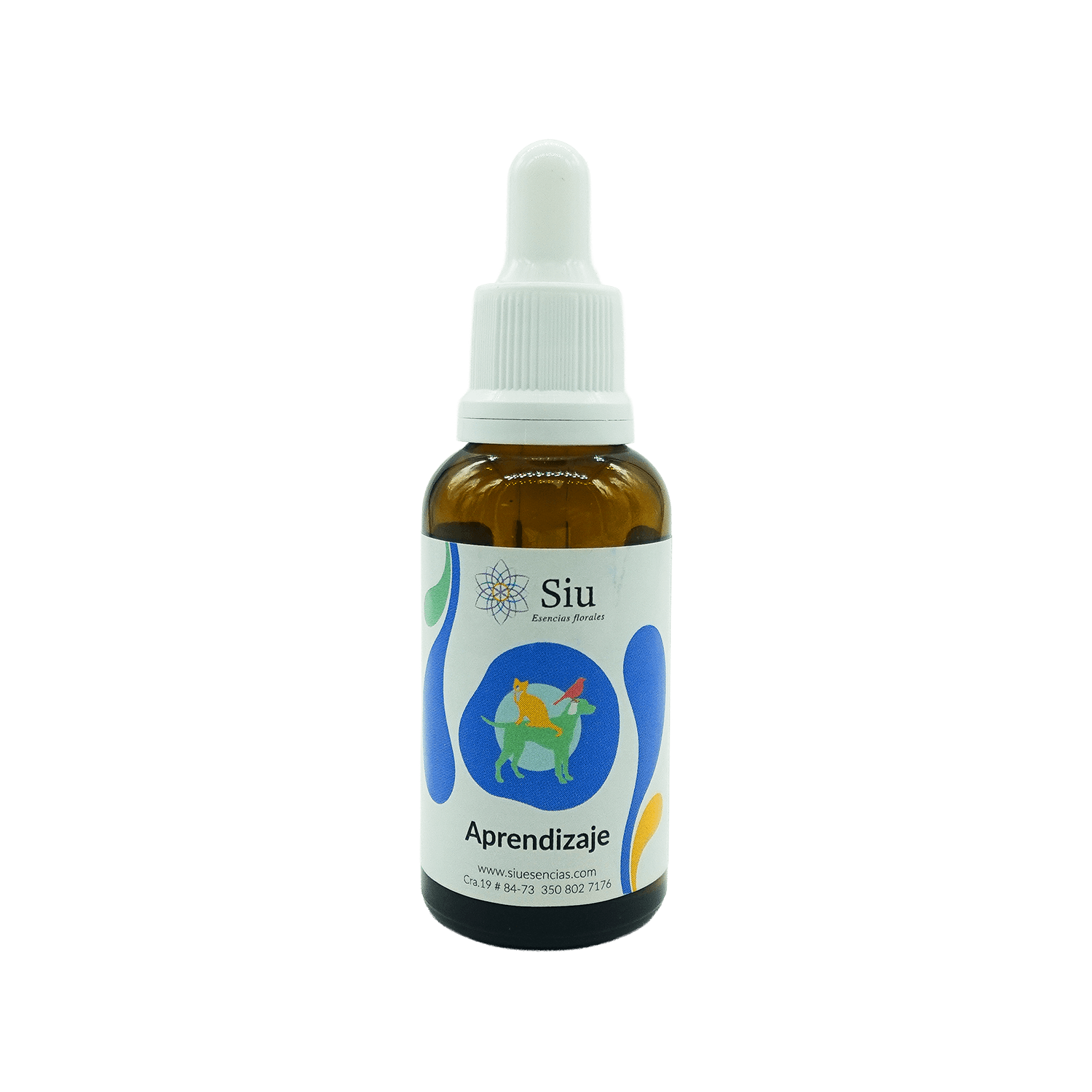
Aprendizaje, by Mascotas Siu, is a flower essence designed as a wellbeing complement during stages such as training, teething and those months when energy and curiosity seem to have no limits.
It can be part of a supportive routine, but it doesn’t replace what a puppy really needs to develop: respectful training, rest, play, supervision and veterinary care when needed. Flower essences are a wellbeing complement; they do not cure or treat illnesses and do not replace the assessment, diagnosis or treatment of a veterinarian.
This stage passes too
Teething can feel endless when you have spent weeks finding bite marks where you least expected them. But it doesn’t last forever. Little by little, baby teeth make way for adult teeth, and your puppy also learns something important: not everything it finds is made for chewing.
Behind that puppy that seems to want to chew everything there isn’t a little home wrecker, but an animal that is growing, exploring and learning to live with you.
Related products
A flower essence can accompany your puppy’s wellbeing during its first months, while it learns, explores and adapts to new stages.